
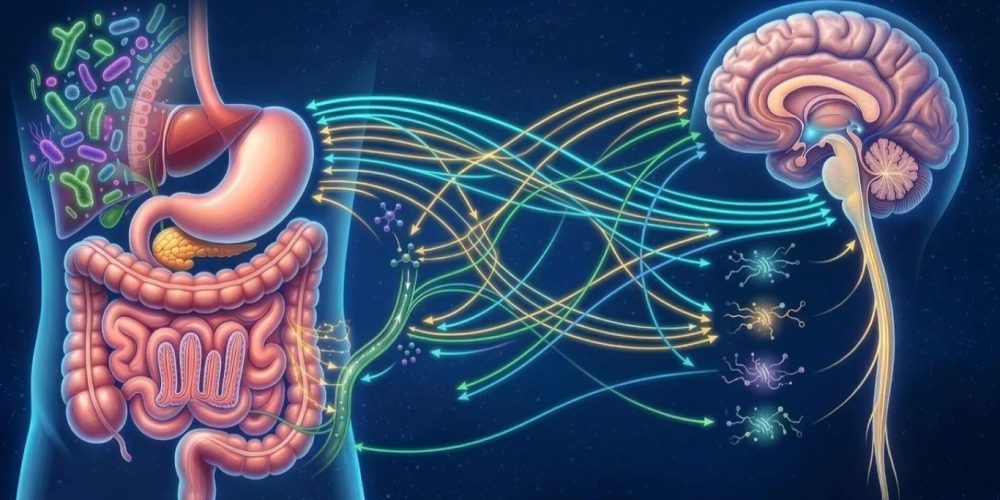
If you’ve spent any time exploring somatic practices, meditation, or stress recovery, you’ve probably run into a familiar problem.
You learn about the autonomic nervous system, then the vagus nerve, then Polyvagal Theory, then nervous system regulation… and it can start to feel like you’re collecting pieces of different puzzles.
But they’re not separate puzzles. They’re all describing the same system from different angles.
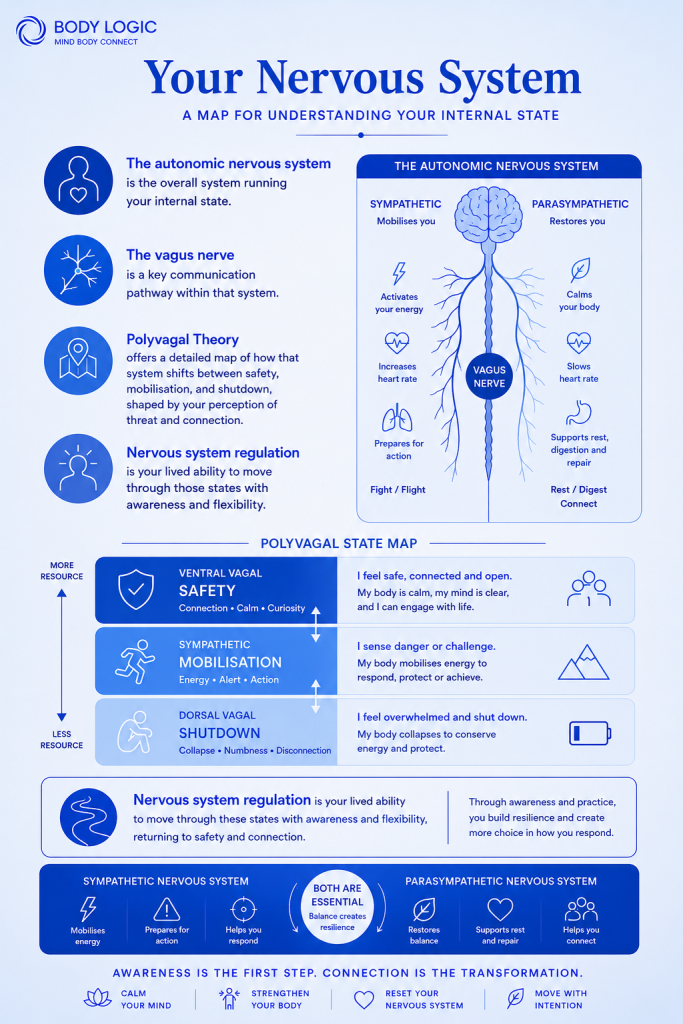
A helpful way to think about it is this: your body is the system, the vagus nerve is a key communication line inside it, Polyvagal Theory is a modern map explaining how that system responds to safety and threat, and regulation is your ability to work with it in real life.
Once you see it this way, everything starts to simplify.
The Autonomic Nervous System: Your Body’s Automatic Control Centre
Your autonomic nervous system (ANS) is the part of you that runs in the background all day, every day.
You don’t consciously tell it to beat your heart, digest your food, regulate your temperature, or adjust your breathing. It just does it.
At its core, the ANS is constantly scanning one thing: “Am I safe right now?” Based on its answer, it adjusts your entire physiology.
For a long time, this system was explained in two main parts. One branch prepares you for action. The other helps you recover.
The first is the sympathetic nervous system. This is your activation system. When something feels challenging or threatening, it kicks in and gets you ready to respond. Your heart rate increases, your muscles tighten, your focus sharpens, and stress hormones like adrenaline rise. This is what people call fight-or-flight.
This system isn’t bad. In fact, you rely on it to perform, train, meet deadlines, and respond to real danger. The issue is not activation itself, but staying stuck in it for too long.
The second branch is the parasympathetic nervous system, often described as rest-and-repair. When it’s active, your heart rate slows, digestion improves, and your body shifts toward recovery and restoration.
For years, that was considered the full story: stress mode versus rest mode.
But the lived experience of humans is more complex than a simple on/off switch.
Polyvagal Theory: A More Nuanced Map of the Same System
This is where the work of neuroscientist Stephen Porges becomes important.
His Polyvagal Theory builds on the autonomic nervous system model rather than replacing it. It suggests that your nervous system doesn’t just switch between “stressed” and “calm.” Instead, it moves through a hierarchy of survival responses depending on how safe or unsafe you feel.
At the centre of this model is the vagus nerve, a major communication pathway between your brain and body.
Rather than two states, Polyvagal Theory describes three broad physiological patterns – not as boxes you fall into, but as patterns your system moves through.
1. Safety and Connection (Ventral Vagal State)
This is the state where you feel most like yourself. When your system is here, there’s a sense of calm presence. You feel socially engaged, curious, and able to respond rather than react. Your body feels grounded rather than braced.
This is the state where learning, creativity, connection, and emotional flexibility are most available.
Importantly, this isn’t a “relaxed bubble” where nothing bothers you. It’s a regulated state where you can meet life without becoming overwhelmed by it.
2. Activation (Sympathetic State)
When your system detects challenge or threat, it shifts into mobilisation.
This is where anxiety, irritability, restlessness, or urgency can appear. Thoughts may speed up. Muscles tighten. Breathing becomes shallower. This is the classic fight-or-flight response.
Again, this isn’t a malfunction. It’s a survival response designed to help you act quickly and effectively.
The challenge comes when your system doesn’t get the message that the danger has passed.
3. Shutdown (Dorsal Vagal State)
If a situation feels overwhelming and there’s no clear way to fight or escape, the nervous system may shift into conservation mode.
This can feel like fatigue, numbness, heaviness, disconnection, or emotional flatness. Some people describe it as feeling foggy, detached, or collapsed.
This state is protective. It’s your system trying to reduce energy use when things feel too much. It often shows up in burnout, chronic stress, or unresolved trauma patterns.
The Vagus Nerve: The Body-Brain Communication Highway
The vagus nerve is one of the most important players in all of this.
It runs from the brainstem through the neck and into the heart, lungs, and digestive system. The name ‘vagus’ means ‘wandering’, which makes sense given how widely it travels.
But here’s the key detail many people miss: most vagus nerve signalling travels from the body to the brain, not the other way around.
That means your brain is constantly being updated about what’s happening inside your body, including your breath, heart rhythm, gut activity, and muscle tension.
These signals shape how safe or unsafe you feel in real time.
This is why body-based practices can be so powerful. You’re not just ‘thinking’ your way into calm. You’re influencing the signals your brain receives.
Vagal Tone: Your System’s Flexibility
You may also hear the term ‘vagal tone’.
This refers to how effectively your vagus nerve helps regulate your nervous system.
Higher vagal tone is generally associated with better stress recovery, more emotional resilience, improved heart rate variability, and greater adaptability in social and emotional situations.
The important part? Vagal tone is not fixed. It’s not something you either have or don’t have. It adapts based on experience, environment, and practice.
Nervous System Regulation: What It Actually Means
This is where things often get misunderstood. Nervous system regulation does not mean staying calm all the time.
That’s not realistic, and it’s not even desirable. Regulation means flexibility. It’s your ability to move between states without getting stuck.
A regulated system can feel stress, respond to it, and then return to baseline. It can activate when needed and settle when the situation changes.
A dysregulated system tends to get ‘stuck’ in one direction – either over-activated or shut down – and struggles to return to balance.
For example, imagine two people before a presentation. One feels nervous beforehand, performs the presentation, and then settles afterwards. That’s regulation.
Another feels anxious for days, becomes overwhelmed during the event, and stays activated long after it’s finished. That’s dysregulation. The goal isn’t to avoid stress. It’s to recover from it.
How the Body Learns Regulation
This is where somatic practices come in. Instead of focusing only on thoughts, somatic approaches work with the body’s direct experience.
Practices like slow movement, breath awareness, grounding, body scanning, and mindful attention help the nervous system update its sense of safety.
Over time, this can support vagal tone, reduce chronic tension, improve interoception (your ability to sense internal signals), and create new patterns of regulation through neuroplasticity.
In simple terms, your body learns that it has more options than survival mode.
Bringing It All Together
Once you step back, the picture becomes much clearer.
- The autonomic nervous system is the overall system running your internal state.
- The vagus nerve is a key communication pathway within that system.
- Polyvagal Theory offers a detailed map of how that system shifts between safety, mobilisation, and shutdown, shaped by your perception of threat and connection.
- And nervous system regulation is your lived ability to move through those states with awareness and flexibility.
None of these ideas are competing. They’re describing different layers of the same biological reality. At its core, this is not just neuroscience. It’s lived experience.
It’s what it feels like to be overwhelmed, to come back to yourself, to lose balance, and to find it again. And perhaps most importantly, it’s a reminder that regulation isn’t about becoming permanently calm.
It’s about helping your system remember that it can return to safety.
Scientific References
Breit, S., Kupferberg, A., Rogler, G., & Hasler, G. (2018). Vagus nerve as modulator of the brain–gut axis in psychiatric and inflammatory disorders. Frontiers in Psychiatry, 9, 44.
Craig, A. D. (2002). How do you feel? Interoception: The sense of the physiological condition of the body. Nature Reviews Neuroscience, 3(8), 655–666.
Kolb, B., & Gibb, R. (2011). Brain plasticity and behaviour in the developing brain. Journal of the Canadian Academy of Child and Adolescent Psychiatry, 20(4), 265–276.
McEwen, B. S. (2007). Physiology and neurobiology of stress and adaptation: Central role of the brain. Physiological Reviews, 87(3), 873–904.
Porges, S. W. (2011). The Polyvagal Theory: Neurophysiological Foundations of Emotions, Attachment, Communication, and Self-Regulation. W. W. Norton & Company.
Sapolsky, R. M. (2004). Why Zebras Don’t Get Ulcers (3rd ed.). Holt Paperbacks.
Shaffer, F., McCraty, R., & Zerr, C. L. (2014). A healthy heart is not a metronome: An integrative review of the heart’s anatomy and heart rate variability. Frontiers in Psychology, 5, 1040.
Streeter, C. C., Gerbarg, P. L., Saper, R. B., Ciraulo, D. A., & Brown, R. P. (2012). Effects of yoga on the autonomic nervous system, gamma-aminobutyric acid, and allostasis in epilepsy, depression, and post-traumatic stress disorder. Medical Hypotheses, 78(5), 571–579.
Thayer, J. F., & Lane, R. D. (2000). A model of neurovisceral integration in emotion regulation and dysregulation. Journal of Affective Disorders, 61(3), 201–216.