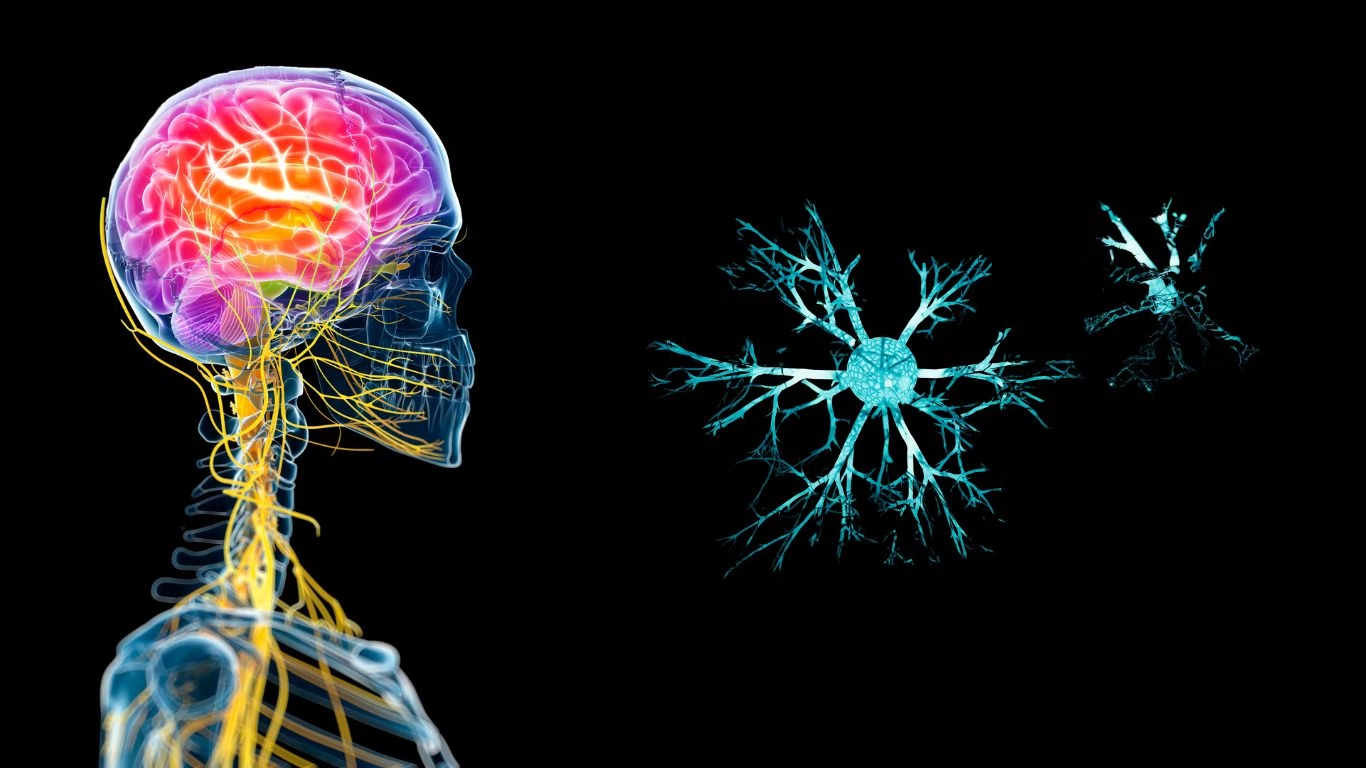

Stress doesn’t just live in your thoughts. It lives in your body.
If you’ve ever felt tight shoulders that never soften, a jaw that aches, or a nervous system that feels permanently “on”, you’ve experienced stored stress in the body.
But why does this happen? And how do you release stress safely without overwhelming yourself? Let’s look at the physiology.
Why the Body Holds Stress
Your nervous system is designed for survival.
When you perceive a threat (physical, emotional, or psychological) your autonomic nervous system mobilises into a protective state commonly known as fight, flight, or freeze. This response is intelligent and adaptive.
Your heart rate increases.
Blood flow shifts to large muscles.
Breathing changes.
Stress hormones such as cortisol and adrenaline surge.
In an ideal situation, once the threat has passed, your nervous system discharges the activation and returns to baseline. You move. You breathe. You reconnect socially. The cycle completes. However, in modern life, stress rarely resolves cleanly.
Chronic workload pressure, emotional strain, digital stimulation, financial stress, relational conflict and uncertainty create repeated activation, without resolution.
Instead of completing, the stress response remains partially activated. This is what people often mean when they say the body holds stress.
What Is Stored Stress?
Stored stress refers to unresolved autonomic activation that remains active in the nervous system and musculature.
It can manifest as:
- Chronic muscle tension
- Digestive disturbances
- Persistent fatigue
- Anxiety without clear trigger
- Sleep disruption
- Emotional reactivity
- Feeling “wired but tired”
The body isn’t malfunctioning. It is protecting. From a nervous system perspective, the system remains in a guarded state because it has not yet received enough cues of safety to fully settle.
Is Trauma Stored in the Body?
Trauma is not simply the event that occurred. It is what happened inside the nervous system when the body could not complete its survival response.
If mobilisation is blocked, for example, if escape isn’t possible, the nervous system may shift into freeze or shutdown. If that activation cannot integrate, the body continues to organise around protection.
This is why cognitive insight alone doesn’t always resolve stress patterns. Understanding what happened is helpful, but regulation occurs through physiology. The body must experience safety directly.
How to Release Stress from the Body Safely
The key word is safely. Attempting to “force release” through intense catharsis or dramatic emotional expression can dysregulate the nervous system further if capacity has not yet been built. Effective somatic stress release follows three principles:
1. Regulation Before Release
The nervous system needs stability before it can process stored activation.
2. Small, Tolerable Doses
Integration happens gradually within what is called your window of tolerance.
3. Bottom-Up Awareness
Instead of analysing thoughts, you gently track sensations.
Simple starting practices include:
- Lengthening the exhale slightly longer than the inhale
- Gently rocking or swaying while seated
- Slowly orienting visually around the room
- Noticing neutral or pleasant sensations in the body
These practices may seem subtle, but they send powerful cues of safety to the nervous system. Safety allows activation to unwind organically.
Why Somatic Work Is Different
Many stress management strategies focus on cognitive control, but somatic work focuses on physiological retraining.
Rather than suppressing stress, it builds regulation capacity. Over time, this increases vagal tone, flexibility and emotional resilience.
This is the foundation of somatic release training. If you’d like to begin gently, download the Somatic Starter Pack for guided regulation practices.
If you’re interested in learning how to apply these principles professionally, explore the Certified Somatic Release Facilitator training and understand the science behind nervous system retraining.
Stress isn’t stored because you are broken. It’s stored because your body is adaptive. And it can learn safety again.