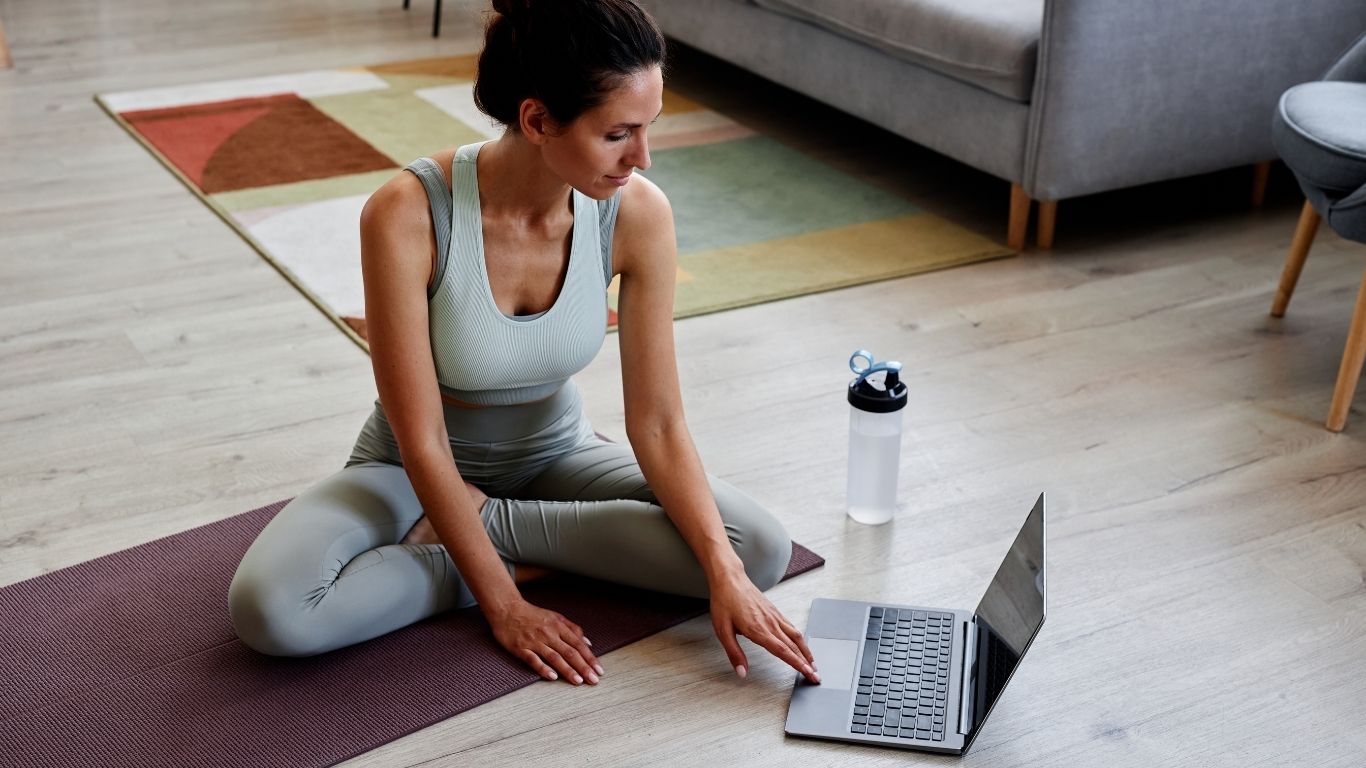

If you experience anxiety, you may notice that it is not just a mental experience. It’s also physical. Your heart may beat faster, your breathing can become shallow, your muscles may tense and your body may feel restless or unsettled.
This is because anxiety involves the whole nervous system, not just your thoughts.
Somatic movement for anxiety offers a way to work with these physical responses through gentle movement, body awareness and attention to sensation. Rather than trying to force anxiety away, the aim is to help you notice what is happening in your body and gradually develop a greater sense of safety and control.
What is somatic movement?
Somatic movement involves paying attention to your internal physical experience while you move. Instead of focusing primarily on how a movement looks, you notice how it feels.
You might become aware of:
- Where you are holding tension
- Changes in your breathing
- Your heart rate
- How much effort you are using
- Whether a movement feels comfortable or uncomfortable
- Changes in temperature, pressure or sensation
This approach can encourage a different relationship with the body. Instead of automatically reacting to uncomfortable sensations, you practise noticing them with curiosity.
Why can anxiety feel so physical?
Anxiety activates the body’s threat-response systems. When your brain perceives danger – whether the threat is immediate, anticipated or simply imagined – your body can prepare to respond.
Muscles may tighten. Breathing may change. Your attention may become focused on potential problems. You might feel restless, shaky, tense or unable to settle.
These responses are not necessarily signs that something is wrong with your body. They are part of a protective system designed to help you respond to perceived threat.
The difficulty can arise when this state becomes frequent or difficult to switch off.
How can somatic movement help?
Somatic practice gives you an opportunity to slow down and observe these responses rather than immediately reacting to them.
For example, you might gently roll your shoulders while noticing where you feel resistance. You could make the movement smaller, slow it down and pay attention to whether your breathing changes.
This is about developing body awareness. Over time, this type of practice may help you recognise early signs of tension or activation. That awareness can give you more opportunity to pause, adjust what you are doing and choose how you want to respond.
A simple somatic movement practice for anxiety
Try this for a few minutes:
1. Notice – Sit or stand comfortably. Notice your breathing, posture and any areas of tension without trying to change them.
2. Move – Choose one small movement, such as slowly turning your head or rolling your shoulders. Keep the movement comfortable and easy.
3. Slow down – Repeat the movement more slowly. Reduce the amount of effort you use.
4. Reassess – Pause and notice what has changed. Your breathing, muscle tension or sense of ease may be different, or they may not. There is no particular sensation you need to achieve.
The practice is simply to notice, move and reassess.
Somatic movement isn’t about forcing yourself to relax
One of the most important principles of somatic movement is that relaxation cannot always be forced. If you approach movement with the goal of “I need to make my anxiety disappear,” you may end up monitoring yourself even more closely.
Instead, somatic practices encourage a more curious approach: What am I noticing right now? What happens if I make this movement smaller? What changes when I slow down?
This can make movement less about controlling the body and more about listening to it. The goal is greater awareness, not the absence of anxiety
Anxiety is a normal human response. Somatic practice does not need to eliminate it to be useful. The goal can be much simpler: becoming more aware of your body’s signals, recognising changes in activation and developing more options for responding.
With regular practice, gentle movement and body awareness can become another tool for supporting your relationship with anxiety – one that starts not with fighting the body, but with learning to listen to it.
Research and resources
- Clemente, R., Murphy, A. & Murphy, J. (2024) — “The relationship between self-reported interoception and anxiety: A systematic review and meta-analysis” Neuroscience & Biobehavioral Reviews
- Snell et al. (2026) — “The relationship between interoception and anxiety, stress and obsessive-compulsive disorders in adult clinical populations” Journal of Affective Disorders
- Su et al. (2026) — “The effects of exercise on generalized anxiety symptoms in adults: A systematic review and meta-analysis” BMC Sports Science, Medicine and Rehabilitation
- Hofmann et al. (2010) — “The effect of mindfulness-based therapy on anxiety and depression: A meta-analytic review”
- NCCIH — Meditation and Mindfulness: Effectiveness and Safety