
If you’ve ever noticed tight shoulders during stress, a clenched jaw during anxiety, or a sense of “switching off” when overwhelmed, you’ve already experienced the connection between your body and nervous system.
Body awareness exercises help you reconnect with those internal signals so you can regulate stress, improve emotional awareness, and feel more grounded in daily life. They’re a core part of somatic movement and nervous system regulation practices because awareness is often the first step toward change.
In simple terms, body awareness means paying attention to physical sensations, posture, breathing, movement, and internal feelings without immediately trying to fix them.
And the good news is: you don’t need experience with meditation or yoga to begin.
Why Body Awareness Matters
Modern life keeps many people stuck in “thinking mode”. We spend hours in front of screens, rushing between tasks, and overriding physical signals like fatigue, tension, hunger, or stress.
Over time, this disconnect can contribute to nervous system dysregulation, chronic tension, burnout, and emotional overwhelm.
Research in somatic science and neuroscience shows that the body and brain constantly communicate through systems like the vagus nerve, fascia, breath patterns, and the autonomic nervous system.
When you increase body awareness, you improve what’s called interoception, which is your ability to sense what’s happening inside your body. This helps support emotional regulation, stress recovery, and nervous system balance.
The key is starting gently.
What Are Body Awareness Exercises?
Body awareness exercises are simple practices that help you reconnect with what is happening inside your body in the present moment. Instead of staying completely focused on thoughts, tasks, or external distractions, these exercises encourage you to notice physical sensations, breathing patterns, posture, movement, and emotional responses as they arise.
They are commonly used in somatic movement, mindfulness, and nervous system regulation practices because they help strengthen the connection between the brain and body.
Many people move through daily life disconnected from their physical state without realising it. Stress can show up as tight shoulders, shallow breathing, jaw tension, digestive discomfort, fatigue, or restlessness, yet we often ignore those signals and keep pushing through.
Body awareness exercises help bring attention back to those patterns so the nervous system has an opportunity to regulate rather than remain stuck in stress mode.
This process of noticing internal sensations is known as interoception, which plays an important role in emotional regulation and overall nervous system health. Through regular practice, people often become better at recognising stress earlier, understanding how emotions affect the body, and responding to tension before it becomes overwhelming.
Body awareness exercises can take many forms. Sometimes they involve slow breathing, grounding practices, body scans, gentle stretching, or subtle somatic movements. Other times, they are as simple as pausing during the day to notice how your body feels.
The goal is not to perform the exercises perfectly. The goal is to build a clearer and more consistent relationship with your body so you can move through life with greater awareness, regulation, and balance over time.
The Benefits of Regular Body Awareness Exercises
Like any nervous system practice, body awareness exercises work best when they’re done consistently rather than intensely.
A few minutes each day is often more effective than doing a long session once every few weeks. That’s because the nervous system changes through repetition.
Each time you pause, notice your body, regulate your breathing, or reconnect with sensation, you reinforce new neural pathways linked to safety, awareness, and self-regulation.
Over time, regular body awareness practices may help:
- Reduce chronic stress and tension
- Improve emotional regulation
- Increase resilience to overwhelm
- Support better sleep and recovery
- Improve posture and breathing habits
- Enhance focus and mental clarity
- Strengthen the mind-body connection
- Increase awareness of early stress signals before burnout develops
Research into neuroplasticity shows that the brain and nervous system are capable of adapting throughout life. Practices involving mindful movement, breath awareness, and interoception help support this adaptive process by teaching the body to shift out of chronic stress patterns more efficiently.
Regular body awareness exercises may also improve vagal tone. Vagal tone is linked to parasympathetic nervous system activity, which is the “rest and restore” state associated with recovery, digestion, immune support, and emotional balance.
Importantly, these exercises aren’t about “performing wellness perfectly”. They’re about building a more consistent relationship with your body.
The more regularly you practise noticing tension, breath, posture, movement, and sensation, the easier it becomes to recognise when your body needs rest, grounding, movement, or support.
That ongoing awareness can have a significant effect on overall health because stress is often cumulative. Small moments of regulation repeated daily can help prevent the long-term build-up of physical and emotional strain.
Many people notice that regular somatic and body awareness practices gradually create:
- More emotional stability
- Better stress tolerance
- Improved body confidence
- Greater presence and calm
- A stronger sense of connection to themselves
In other words, body awareness exercises are not just relaxation tools. They are a way of training the nervous system toward greater balance, adaptability, and long-term wellbeing.
5 Simple Body Awareness Exercises for Beginners
1. Feet-on-the-Floor Grounding
This is one of the easiest body awareness exercises to begin with. Sit or stand comfortably and place your attention on your feet.
Notice:
- The pressure against the floor
- Temperature differences
- Weight distribution
- Any tingling or tension
You don’t need to change anything. Just observe. This type of grounding exercise helps activate proprioception (your body’s sense of position and support) while signalling safety to the nervous system.
Try this for 30–60 seconds whenever you feel stressed or mentally scattered.
2. Slow Breath Awareness
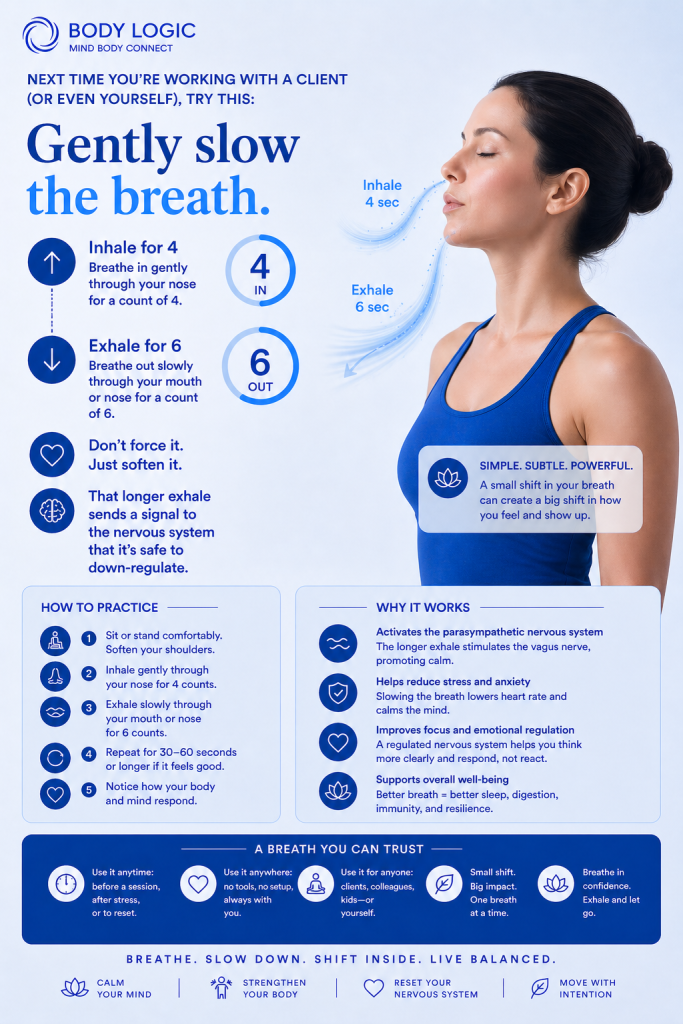
Your breath reflects the state of your nervous system. Instead of forcing deep breathing, simply notice:
- Is your breath shallow or deep?
- Fast or slow?
- Mostly in the chest or belly?
Then gently lengthen your exhale. A simple pattern is: Inhale for 4, then exhale for 6. The longer exhales help stimulate parasympathetic activity, which supports relaxation and regulation. The goal isn’t “perfect breathing”. It’s becoming aware of your internal state.
3. Body Scan Check-In
A body scan is a simple way to reconnect with sensations you may normally ignore. Close your eyes if comfortable and slowly move your attention through the body:
- Head
- Jaw
- Neck
- Shoulders
- Chest
- Stomach
- Hips
- Legs
- Feet
Notice areas of tightness, warmth, heaviness, tingling, or numbness. There’s no need to analyse the sensations. Awareness itself can help the nervous system begin releasing tension.
This exercise is especially useful before sleep or after stressful days.
4. Gentle Micro-Movements
Many people think movement has to be intense to be effective, but slow and subtle movement can have a powerful effect on the nervous system.
Try:
- Rolling your shoulders slowly
- Rocking gently side to side
- Tilting the pelvis while seated
- Making tiny neck circles
Move slowly enough that you can actually feel the movement. Somatic practices often use micro-movements to improve proprioception, release stored tension, and create new nervous system patterns through neuroplasticity. The slower you go, the more awareness you build.
5. Orienting to Your Environment
Orienting is a nervous system exercise that helps the body recognise safety in the present moment. Slowly look around the room and notice:
- Colours
- Shapes
- Light
- Sounds
- Objects that feel calming or familiar
This simple practice can help shift the body out of stress-driven states and back into grounded awareness. It’s particularly helpful if you feel anxious, overwhelmed, or mentally “stuck”.
Start Small and Stay Consistent
You don’t need a long wellness routine to benefit from body awareness exercises.
Even a few minutes a day can help you feel calmer and more grounded, recognise stress earlier, improve emotional awareness, support nervous system regulation, and reconnect with your body
The important thing is consistency, not intensity.
Body Logic’s somatic courses teach practical somatic movement, nervous system regulation, mindfulness, and body awareness practices designed for real everyday life. Our training combines modern neuroscience with embodied movement approaches to help you build greater resilience, regulation, and mind-body awareness over time.